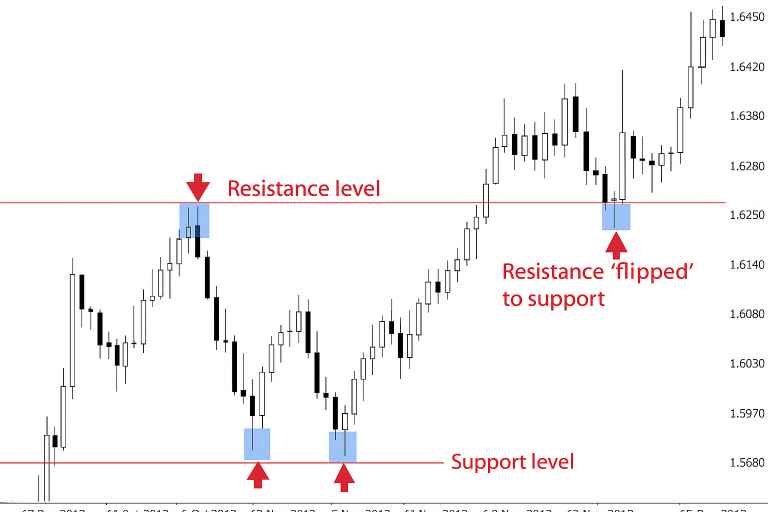
If you want to succeed in trading, one powerful skill to master is how to trade support and resistance.
These levels show you where the market tends to react, giving you a map for potential entries and exits.
if you’re new to trading please check out our 👉 introduction to forex trading before continuing here
When combined with a Simple Moving Average (SMA), they become even stronger. Many traders lose money because they don’t understand the dynamics of support, resistance, and moving averages.
In this guide, we’ll explore how to trade support and resistance effectively, with practical examples and why cost of an asset reactions around these levels matter.
Understanding Support and Resistance
Before diving deeper into how to trade support and resistance, let’s define them clearly:
Support is a level where falling cost of an asset tends to stop and reverse upward.
Resistance is a level where rising cost of an asset tends to stop and reverse downward.
Think of support as a floor and resistance as a ceiling. Every time cost reaches these areas, it faces a challenge. Knowing how to trade support and resistance means being able to predict where the market might pause or turn.
Why Support and Resistance Work
The reason how to trade support and resistance is effective comes from human behavior and market memory. Traders remember zones where cost reacted before.
Big institutions also place orders at these levels, making them important zones where the market often respects. By recognizing these levels, you increase your chances of trading in line with what the majority of the market is watching.
The Role of SMA in Trading
A Simple Moving Average (SMA) is a tool that smooths cost action and shows the overall direction of the market. For example, the 30 SMA takes the average cost of the last 30 candles and plots it on the chart. When combined with support and resistance, SMA acts like a guide.
Here’s the key:
In an uptrend, cost of an asset often pulls back to the SMA before bouncing higher.
In a downtrend, cost of an asset rallies back to the SMA before dropping lower.
Learning how to trade support and resistance with SMA helps you filter fake signals and trade with more confidence.
Combining Support, Resistance, and SMA
Now let’s see how to trade support and resistance with SMA together. Imagine cost of an asset approaching a support level while also touching the SMA. That’s double confirmation the level may hold. Similarly, if cost of an asset touches resistance at the same spot as the SMA, it’s a stronger barrier. These confluences are what professional traders look for.
Example:
If cost of an asset is trending up, wait for it to pull back near support and touch the 30 SMA. Enter a buy when you see rejection.
If cost of an asset is trending down, wait for it to rally to resistance near the 30 SMA. Enter a sell when rejection shows up.
This simple approach makes how to trade support and resistance much more effective than relying on levels alone.
Common Mistakes to Avoid when trading support and resistance
One mistake beginners make when learning how to trade support and resistance is assuming the exact line must hold perfectly. In reality, these are zones, not single cost points of an asset.Give the market breathing space.
Another mistake is trading against the SMA trend. If SMA shows strong downward slope, don’t buy at support blindly; the downtrend may continue. Always align your trade with the SMA direction.
upwardhabbits conclusion on how to trade support and resistance
Mastering how to trade support and resistance is one of the most valuable skills for traders.
When combined with SMA, it gives you a strong framework to filter fake moves and identify high-probability entries. Remember, support and resistance are not magic — they are simply areas where cost reacts repeatedly.
By respecting these zones and aligning with SMA, you position yourself on the right side of the market more often.The journey of learning how to trade support and resistance takes practice, but once you master it, your trading will never remain the same.
Here are upwardhabbits recommended brokers
Click here to 👉 register with Fbs broker
Click here to 👉 register with Exness broker